

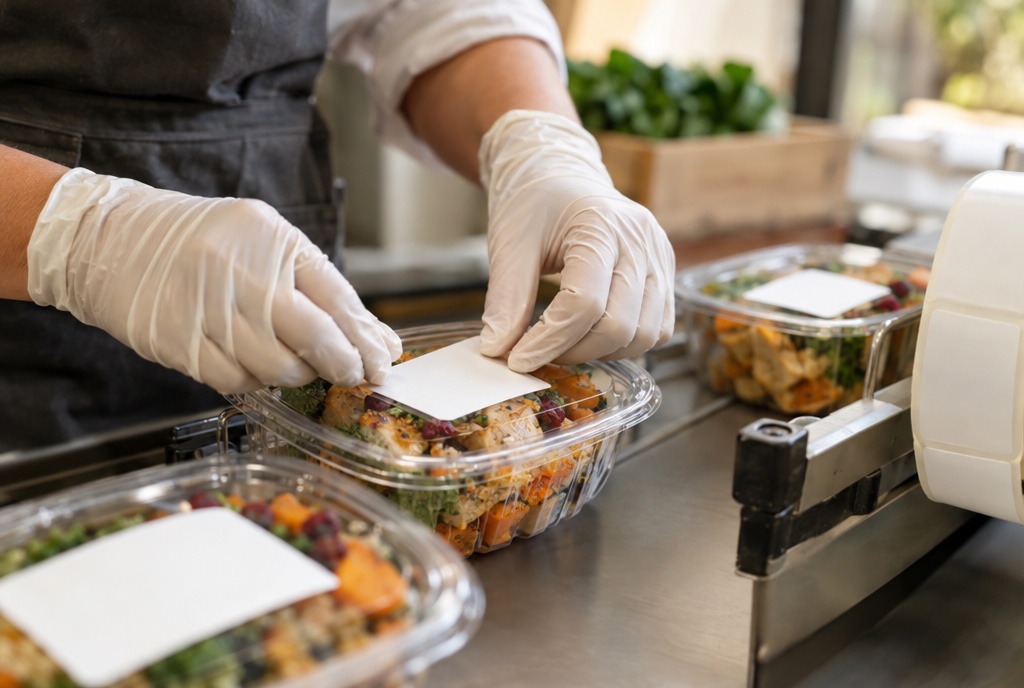
EU food labelling rules require a prepackaged food to carry a set of mandatory information: the name of the food, the list of ingredients (with allergens highlighted), the net quantity, the date of minimum durability or use-by date, storage conditions, the name and address of the food business responsible in the EU, a nutrition declaration, a lot number and, in some cases, the origin. All of it must be in a language the buyer understands, which for the Dutch market usually means Dutch. Below is the general picture to help you prepare your label; the details for each product still need to be confirmed.
Which rules apply to EU food labelling?
The general framework for prepackaged food sold in the EU is Regulation (EU) No 1169/2011 on the provision of food information to consumers. It applies in every Member State, including the Netherlands. In addition, some product groups (alcoholic drinks, food supplements, organic products and others) have their own specific rules. So please do not treat this article as legal advice. Confirm the details for your product with the competent authority or with the Miss Linh team before you print large quantities.
Mandatory information on an EU food label
| Item | Practical note |
|---|---|
| Name of the food | A name that describes what the product really is, not just the brand name. |
| List of ingredients | In descending order by weight. Additives are listed by functional class together with the name or E number. |
| Allergens | Must be emphasised within the ingredients list (bold, capitals or underlining). |
| Net quantity | Given in g, kg, ml or l. |
| Date of durability | "Best before" or "use by", depending on the type of product. |
| Storage conditions and instructions for use | Required where, without them, the consumer could not store or use the food properly. |
| Responsible food business | Name and address of the business responsible for the food information in the EU (usually the importer or the company that sells under its own name on the EU market). |
| Nutrition declaration | Per 100 g or 100 ml: energy (kJ and kcal), fat, saturated fat, carbohydrate, sugars, protein and salt. |
| Lot number | For traceability if something goes wrong. |
| Origin | Mandatory in some cases, and advisable where leaving it out could mislead the buyer. |
Language and presentation of the label
Mandatory information must be easy to understand for consumers in the country where the product is sold. For the Netherlands, prepare a Dutch version. You may add English or Vietnamese, but they do not replace it. Text must be large enough, clear, legible and not hidden; the rules set a minimum character size, so check this when you design your packaging.
A Vietnamese-style "production date" does not replace a durability date in the EU format. State the date in the form the EU requires. Also remember that goods must arrive at the warehouse in the Netherlands with enough shelf life left for European buyers.
Allergens and common mistakes
The EU has a list of 14 allergen groups that must be emphasised, including cereals containing gluten, soy, peanuts, tree nuts, eggs, milk, fish, crustaceans, sesame and sulphites (above a certain threshold). Vietnamese dipping sauces, noodles and snacks often contain soy, wheat, fish or sesame, so review your recipe carefully. For sauces, you can see how products are grouped in the sauces and condiments category.
Common mistakes:
- A label only in Vietnamese or English, with no Dutch.
- A nutrition table that lists sodium instead of salt, or only per-serving values without figures per 100 g/100 ml.
- Allergens that are not highlighted.
- No name and address of the responsible business in the EU.
- Using claims such as "healthy", "good for you" or "organic" without meeting the conditions. Health claims may only be used as the EU rules allow, and "organic" requires the proper certification.
- A missing lot number or an unclear durability date.
Steps to check your label before printing
- List all ingredients and additives, including sub-ingredients within raw materials.
- Identify the allergens, and consider a cross-contamination warning where there is a risk.
- Calculate nutritional values per 100 g or 100 ml, preferably based on lab results or a valid calculation method.
- Decide which business will be responsible in the EU and which address goes on the label.
- Send your label design for review before printing large quantities. Correcting a file costs far less than reprinting an entire shipment.
How can Miss Linh help?
Miss Linh is a B2B platform where Vietnamese producers sell their products in their own name to restaurants, shops, supermarkets and wholesalers in Europe. The producer takes care of food-safety certificates (such as HACCP or ISO), EU-compliant labelling and packaging, an EORI number and a Dutch VAT number; Miss Linh helps you with each of these steps. We also advise from the start on whether your product can be sold in the EU. You can read more about becoming a supplier or look at the producers already on Miss Linh. If you would like to send us your label to talk it through, contact the Miss Linh team; we speak Vietnamese, Dutch and English.
Frequently asked questions
Does a label for the Netherlands have to be in Dutch?
Mandatory information must be in a language consumers in the country of sale can understand. For the Netherlands, in practice that is usually Dutch. Confirm this for your specific product with the competent authority or with Miss Linh.
Can I put a Dutch sticker on top of a Vietnamese package?
Many producers use an additional label, as long as it is durable, clear, does not cover mandatory information and is accurate. Still, agree on the approach and the position of the sticker beforehand, rather than deciding after the goods have been produced.
Do I need to print a production date?
What the EU requires is a durability date (best before or use by). A production date is not mandatory, but you may add it for internal management if it does not cause confusion.
Do I need to write "Made in Vietnam"?
Origin is only mandatory in certain cases, but stating Vietnam as the origin is usually good practice, especially if the packaging has images or text that could suggest another place. Check the rules that apply to your product.