

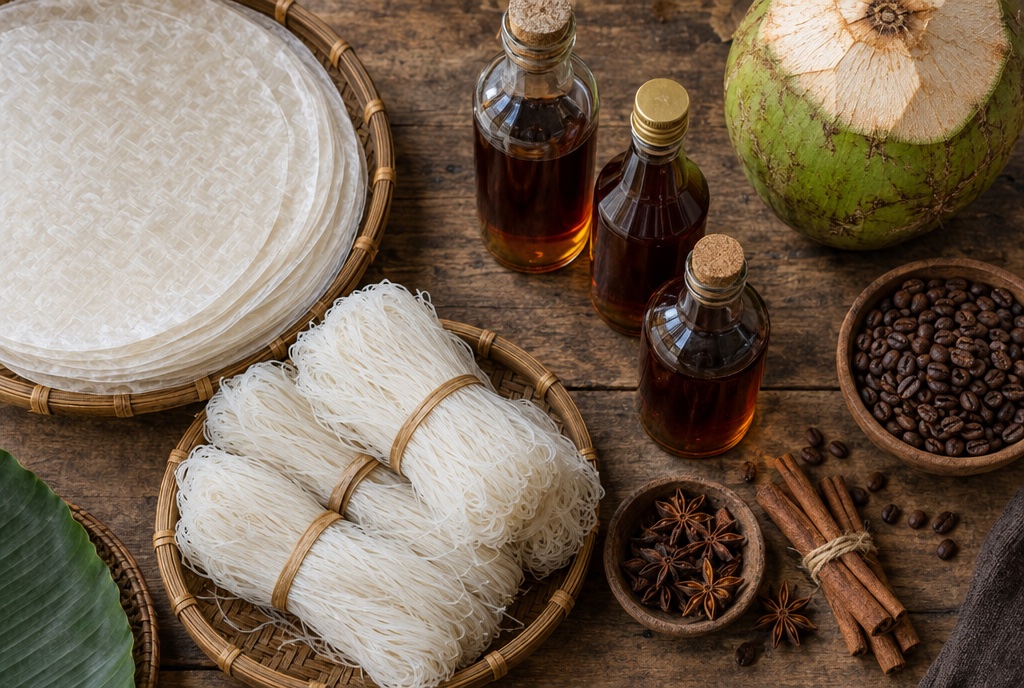
If you are asking which Vietnamese food products are in demand in Europe, the short answer is: dry, packaged, long-life products linked to Vietnamese or Asian cuisine, such as rice paper, sauces, noodles and vermicelli, coconut products, coffee, tea, spices and snacks. We have no statistics to quote here, so this article gives the general picture and the points to check before you decide.
Where does European demand for Vietnamese food come from?
Buyers in Europe are not only the Vietnamese community. Demand usually comes from several directions:
- Vietnamese and Asian restaurants that need ingredients with the right taste;
- caterers who want to add Asian dishes to their menus;
- Asian grocery shops and specialty food stores;
- supermarkets and wholesalers with an international food range;
- European consumers who enjoy cooking Asian food at home, or who look for natural, healthy and plant-based products.
This is why a product often sells more easily when it is true to the traditional flavour and also easy to use for people who are not familiar with Vietnamese cooking.
Vietnamese food categories worth considering
The table below is a guide to direction, not a promise of demand for any specific product.
| Category | Why it is worth considering | Points to watch |
|---|---|---|
| Rice paper and wrappers | Linked to fresh spring rolls and fried rolls, dishes many people know from restaurants | Full ingredient list and allergen labelling |
| Sauces and condiments | Used by restaurants and home cooks; bottled products keep well | Additives and preservatives must comply with EU rules |
| Dried noodles, vermicelli and pho | Easy to prepare and easy to transport | Shelf life must still be long enough on arrival |
| Coconut products | Fit the plant-based trend and the demand for natural ingredients | State ingredients and storage clearly |
| Coffee and tea | Distinctive products with a clear story of origin | Check residue requirements for each product |
| Spices, nuts and snacks | Easy to trial in small quantities; a good fit for specialty shops | Sealed packaging and correct labelling |
| Soups, broths, meal kits and canned food | Convenient for people with little time | Specific rules depending on the ingredients |
Which products are harder for first-time exporters?
Fresh fruit and vegetables, meat, fish, seafood and products of animal origin are usually subject to much stricter rules, including inspections and separate documents. Products with unusual additives or ingredients that are new to Europe may also need a closer look. Every product is different, so I would not dare to give a general verdict. Confirm the details with the competent authority, or ask Miss Linh to look at your product, before you invest in packaging and a first shipment. This is general information, not legal advice.
How do you know whether your product has a chance?
- Choose a product that can hold its own on the shelf: consistent quality, a distinctive flavour and a long enough shelf life.
- Check whether the product can be sold in the EU: ingredients, additives and product type.
- Prepare the basic documents: a food-safety certificate (for example HACCP or ISO), EU-compliant labelling and packaging, an EORI number and a Dutch VAT number.
- Plan the shelf life: the goods must arrive in Europe with enough shelf life left for European buyers to feel confident.
- Test the market with samples: let buyers taste and give feedback before you send large quantities.
How Miss Linh can help
Miss Linh (Vietnam Food Europe B.V., Oegstgeest, the Netherlands) is a B2B platform and service provider. Vietnamese producers sell their products in their own name to European businesses such as restaurants, caterers, shops, supermarkets and wholesalers. You remain the owner of your products until they are sold; they are stored in a warehouse in the Netherlands, and Miss Linh delivers them to buyers.
Miss Linh helps with advice on whether a product can be sold in the EU, pricing advice, setting up VAT and customs, transport and customs clearance to the warehouse, listing products on the platform, marketing and sales (newsletters, samples, customer visits, trade fairs), order handling, collecting payment, delivery, and complaints and returns. You take care of the food-safety certificates, labelling, packaging, an EORI number and a Dutch VAT number, and we help you with these steps. Miss Linh earns a commission on the products that are actually sold and focuses on small and medium-sized producers, especially women-led businesses.
You can read how to become a supplier on Miss Linh, look at the producers already on the platform, or contact the team (who speak Vietnamese, Dutch and English) to talk about your product.
Frequently asked questions
Which product should I start with when exporting to Europe for the first time?
It is usually best to start with a dry, packaged product that keeps well and has a distinctive Vietnamese flavour. Fresh products and products of animal origin are generally more complicated in terms of regulations.
Can my product be sold in the EU?
It depends on the ingredients, the type of product and how it is made. Confirm the details with the competent authority, or contact Miss Linh for advice on whether your product can be sold in the EU.
Can a small company sell in Europe?
It can. Miss Linh focuses on small and medium-sized producers, especially women-led businesses, and helps you sell directly in your own name without middlemen taking a margin.
Which documents do I need to prepare?
Producers need a food-safety certificate (for example HACCP or ISO), EU-compliant labelling and packaging, an EORI number and a Dutch VAT number. Miss Linh helps you with these steps.