

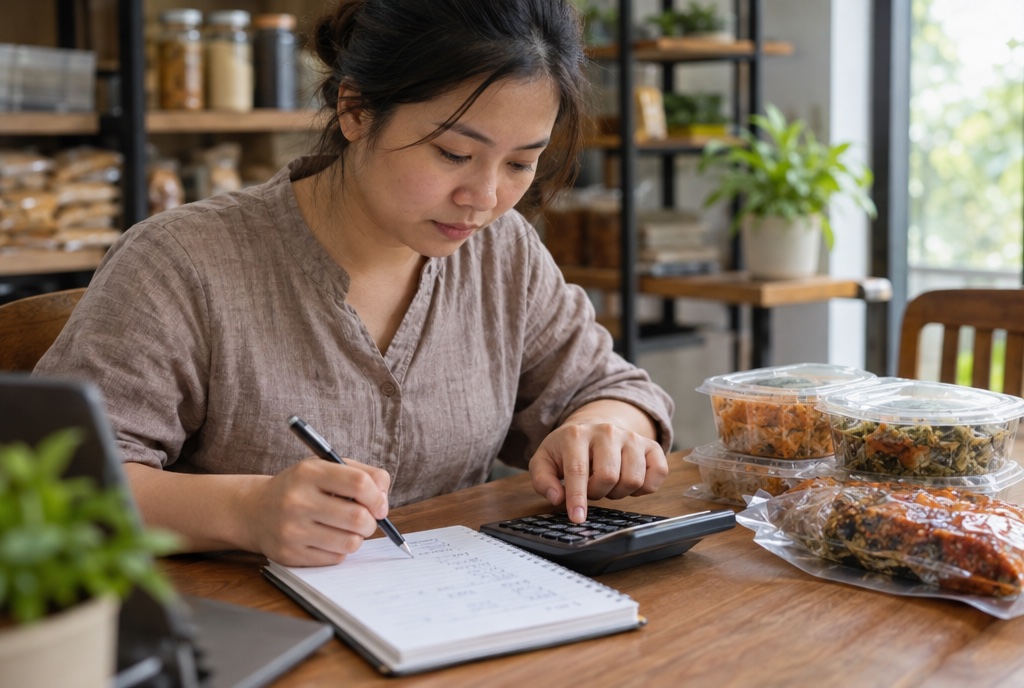
To price food products for Europe, do not simply take your domestic price and add a margin. A more reliable method is to work backwards: see what European buyers charge for similar products, subtract the costs and margin of each link in the chain, and compare the result with your production cost. If what remains still gives you a reasonable profit, the product can move forward. If not, you need to review your packaging, batch size or sales model. This article walks through each step in practical terms.
Start with the price European buyers accept
Many owners calculate from the factory upward: production cost, plus profit, plus shipping. The result is often a price above the market, and nobody knows why. Do it the other way round:
- Visit Asian supermarkets, specialty shops or online wholesale sites in Europe and note the prices of similar products, with the same weight and quality.
- Distinguish between the retail price for consumers and the wholesale price for restaurants and shops. They differ, and you need to know which one you are targeting.
- From that price, subtract the shop’s or wholesaler’s margin, value added tax (VAT) and the remaining costs. What is left is the price you can realistically receive.
We do not give specific percentages, because every product group and sales channel is different. Collect real figures for your own product, or talk to Miss Linh for pricing advice.
The costs to include when pricing food for Europe
A price only means something once it covers the following:
- Production cost: ingredients, labour, losses, depreciation.
- Packaging and labels: labels must meet EU food rules, so your packaging may need to be redone or supplemented.
- Food-safety certificates: for example HACCP or ISO, plus the cost of keeping them valid.
- Transport and customs clearance to a warehouse in Europe.
- Import duties and VAT: the rates depend on your product’s commodity code (HS code). Confirm them with the customs authority or with Miss Linh rather than guessing.
- Storage, order handling and delivery to the buyer.
- Shelf life: goods must arrive with enough shelf life left for European buyers. Products close to expiry get pushed down in price or cannot be sold.
- Sales costs: samples, trade fairs, customer care, complaints and returns.
Build a simple spreadsheet with one line per cost, calculated per unit (one pack, one bottle, one carton). You will quickly see which item is eating your profit.
Choose your sales model: your price depends on who sits in between
The same product gives you a different net price depending on how you sell it. Here is a general comparison:
| Model | What you handle | What to watch in pricing |
|---|---|---|
| Selling to an importer | Delivery on the agreed terms | The importer sets its own margin and often decides the final selling price. You see little of the end price. |
| Exporting directly yourself | Almost everything: taxes, customs, storage, delivery, collecting payment | You keep control of the price, but it takes time, staff and market knowledge. |
| Selling via a B2B platform such as Miss Linh | Certificates, labelling, EORI number, Dutch VAT number (Miss Linh helps with these steps) | You sell in your own name and own the goods until they are sold. Miss Linh earns a commission on products actually sold. |
No model is right for everyone. What matters is that you understand what you pay and what you receive at each step.
How Miss Linh can help with pricing
Miss Linh (Vietnam Food Europe B.V., Oegstgeest, the Netherlands) is a B2B platform and service provider. Vietnamese producers sell their products in their own name to European restaurants, caterers, shops, supermarkets and wholesalers. The goods are stored in a warehouse in the Netherlands and Miss Linh delivers them to buyers, so there is no middleman taking a margin in between.
On pricing, Miss Linh can help you:
- Assess whether your product can be sold in the EU and at what price level.
- Set up VAT and customs, and arrange transport and customs clearance to the warehouse.
- List your products on the platform, handle marketing and sales (newsletters, samples, customer visits, trade fairs), process orders, collect payment, deliver, and deal with complaints and returns.
Miss Linh focuses on small and medium-sized producers, especially women-led businesses. You can read why and how to sell on the become a supplier page, or look at the producers already on Miss Linh to see where your product might fit.
Pricing steps in the right order
- Pick one specific product and pack size to calculate, for example a sauce or a spice. Look at the sauces and condiments or spices categories to see how similar products are presented.
- Collect prices of similar products on the European market.
- Build a cost table from your factory to the buyer’s door.
- Work backwards to find the price you receive and compare it with your production cost.
- Confirm duties, HS code and labelling rules with the competent authority or with Miss Linh.
- Quote clearly and transparently, then adjust after feedback from real buyers.
Common mistakes
- Forgetting losses, damaged goods and returns.
- Quoting too low to win orders, then lacking the margin to continue. A price that is fair to both sides lasts longer than a cheap one.
- Confusing prices excluding VAT with prices including VAT.
- Ignoring shelf life when goods travel by sea.
- Comparing yourself with mass-produced industrial goods when your product is natural and healthy, with its own story.
Frequently asked questions
Should I quote FOB, CIF or delivered to the warehouse?
It depends on the sales model. With importers, FOB or CIF is common. If you sell via Miss Linh, goods are shipped to the warehouse in the Netherlands, so you need to build transport and customs clearance into your price structure. Talk to Miss Linh to agree the calculation that suits your product.
Do B2B prices in Europe include VAT?
In business-to-business trade, prices are usually quoted excluding VAT, but how it applies depends on the case. Confirm with the tax authority or with Miss Linh rather than assuming.
Should I lower my price to compete with products already available in Europe?
Avoid a race to the bottom. Compete on quality, clear origin and the story behind your product. A fair price lets you keep producing and keep long-term relationships with buyers.
How does Miss Linh earn money?
Miss Linh earns a commission on products that are actually sold. The contract details are discussed directly with you.
Where do I start?
Choose one product and build a cost table as described above, then send the information to the Miss Linh team via the contact page. The team speaks Vietnamese, Dutch and English, and will work with you to see whether the product can be sold in the EU and how to price it.