

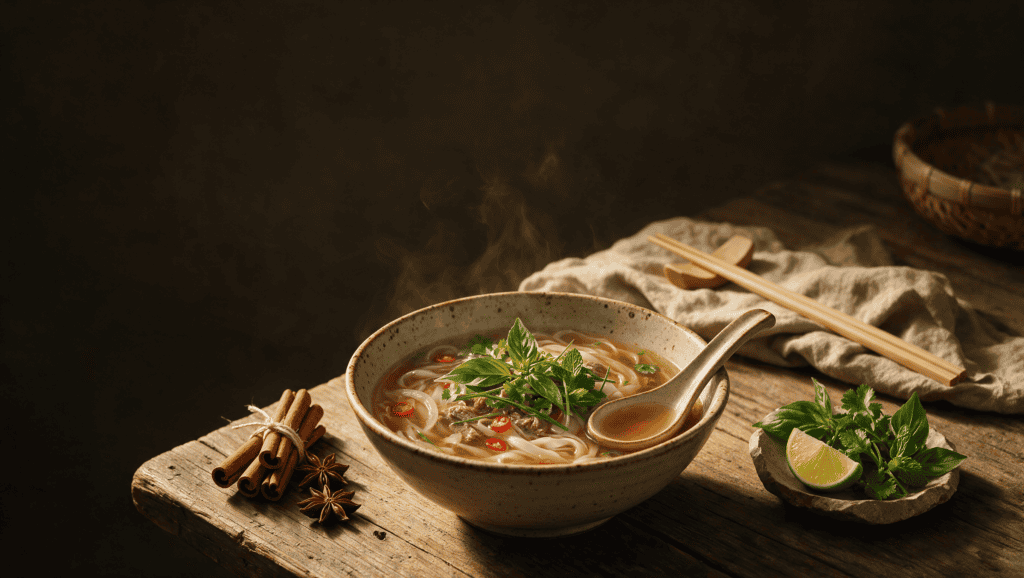
The short answer: yes, you need paperwork, but there is no special permit for “pho” or “bun bo Hue” as such. What you need depends mainly on the ingredients. Concentrated broth made from bones or meat, or containing shrimp paste, is usually subject to the much stricter rules for products of animal origin. Dry spices or plant-based broth mostly have to meet general EU food law: safety, labelling, additives and traceability.
This article explains the general picture. It is not legal advice. For your specific product, please confirm the details with the competent authority (in the Netherlands, the NVWA) or with the Miss Linh team.
First question: does your product contain animal-derived ingredients?
This is the most important dividing line. Go through your recipe carefully, including small ingredients such as beef fat, bone powder, meat extract, fish sauce, shrimp paste or dried shrimp.
| Product type | What to consider |
|---|---|
| Plant-based dry spices (star anise, cinnamon, black cardamom, vegetarian seasoning) | General food law: labelling, additives, residues, contaminants, traceability |
| Vegetarian concentrated broth | As above, plus a careful check of additives, flavour enhancers and allergens |
| Concentrated broth made from bones or meat, or containing shrimp paste or shrimp | Rules for products of animal origin; a veterinary certificate and a check at the border may be required |
| Small seasoning sachets supplied with instant noodles or vermicelli | Depends on the contents of each sachet; the combined product must be considered as well |
If your product contains animal-derived ingredients
The EU only allows products of animal origin from countries and establishments that meet EU conditions. In general, a consignment needs a certificate issued by the competent authority of the exporting country and is inspected at the point of entry. A country may be approved for one product group but not for another.
Whether your concentrated broth falls under this regime depends on the share of animal-derived ingredients, the degree of processing and how the product is classified. This is a complex area and I do not want to guess on your behalf. Ask before you produce your first batch for the EU, because sometimes adjusting the recipe (for example making a vegetarian version) is a much simpler route.
If your product is plant-based or a dry spice mix
You still have to comply with general EU food law. Common points include:
- Additives: only additives permitted in the EU, and only for the right food category. MSG, caramel colour, flavour enhancers and preservatives need careful checking.
- Pesticide residues and contaminants: spices and herbs are a category the EU pays attention to. Importers and inspectors may ask for test results. The EU also keeps a list of products under increased controls, updated from time to time, so check the latest information.
- Traceability: you need to know and record where ingredients come from and where each batch goes.
- Food-contact packaging: materials must be suitable for contact with food under EU rules.
Labelling: the most common mistake
Many Vietnamese products struggle not because of quality but because of the label. An EU label usually needs:
- the product name and an ingredient list in the prescribed order;
- allergens highlighted in the ingredient list (for example soy, wheat, fish, crustaceans, celery, mustard, sulphites);
- net weight, shelf-life date and storage conditions;
- the name and address of the responsible business in the EU or the producer, as required;
- a language suited to the market where you sell (for example Dutch or English, depending on each country’s requirements).
One note: concentrated broth easily contains several allergens at once (soy sauce, fish sauce, celery, onion), so the ingredient list must be precise.
Documents the producer needs to prepare
When you sell via Miss Linh, the producer takes care of the following, and Miss Linh helps with each step:
- a food-safety certificate, for example HACCP or ISO;
- labelling and packaging that comply with EU rules;
- an EORI number;
- a Dutch VAT number.
In addition, products must arrive with enough shelf life left for European buyers to sell and use them. For concentrated broth, factor in transport time from the very start.
How Miss Linh can help
Miss Linh is a B2B platform and service provider: you sell your products in your own name to restaurants, caterers, shops, supermarkets and wholesalers in Europe. You remain the owner of the goods until they are sold. The products are stored in a warehouse in the Netherlands, and Miss Linh delivers them to buyers.
Before you invest, the team can advise whether your product can be sold in the EU, and help with pricing advice, VAT and customs set-up, and transport and customs clearance to the warehouse. After that, Miss Linh lists your products on the platform, handles marketing and sales (newsletters, samples, customer visits, trade fairs), order handling, payment collection and delivery, and deals with complaints and returns. Miss Linh earns a commission on products that are actually sold. You can look at similar products in the soups, broths and meal kits and spices categories, or see the producers already on Miss Linh.
Steps to take now
- List all ingredients and determine whether any are animal-derived.
- Review additives, allergens and the label against EU rules.
- Check that your HACCP or ISO certificate is still valid.
- Ask which rules apply to your product before you ship anything.
- Read about how to become a supplier on Miss Linh and contact the team. The team speaks Vietnamese, Dutch and English.
Frequently asked questions
Is vegetarian pho broth concentrate easier to bring into the EU than a version with beef bones?
Usually it is simpler in terms of paperwork, because it does not fall under the rules for products of animal origin. You still have to comply with the rules on labelling, additives, allergens and food safety.
Does shrimp paste in bun bo Hue seasoning affect the procedure?
It can. Shrimp paste is an animal-derived ingredient and may trigger specific requirements. How the rules apply depends on the content and the classification, so confirm with the competent authority or with Miss Linh before shipping.
Is a HACCP or ISO certificate enough on its own?
No. A food-safety certificate is an important requirement, but you also need a label that meets EU rules, suitable packaging, an EORI number and a Dutch VAT number. Depending on the product, other requirements may apply.
When should I ask for advice?
As early as possible, ideally before you finalise the recipe and design the label. Changing a recipe or label after a batch has been produced is usually more costly. You can contact Miss Linh through the contact page to discuss your product.