

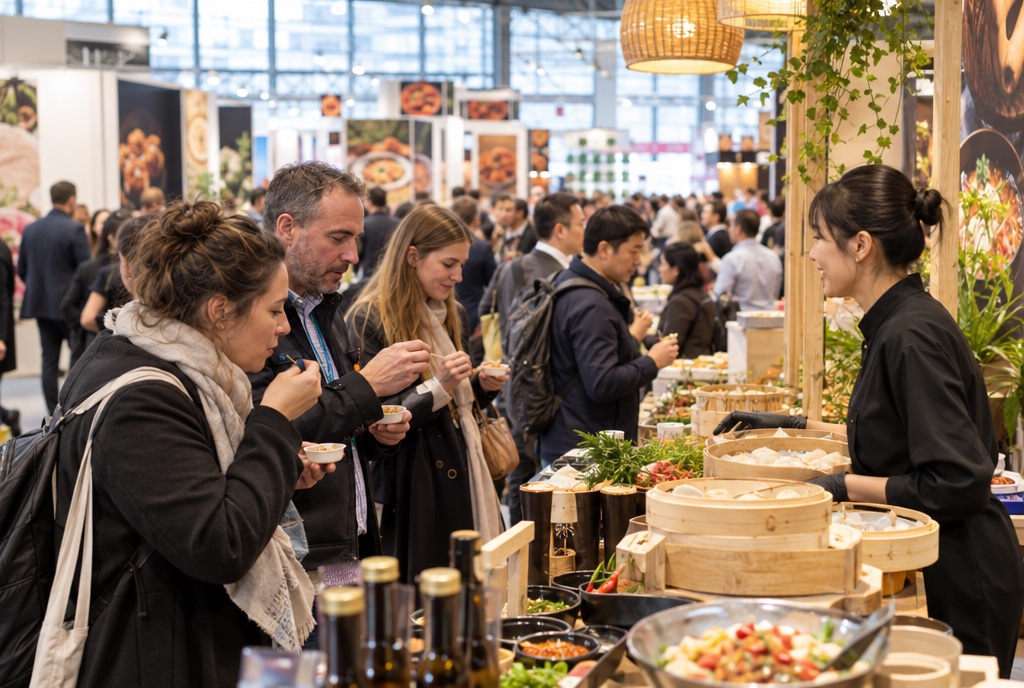
If you are looking for B2B buyers in Europe, the European food trade fairs most worth considering are Anuga (Cologne, Germany) and SIAL Paris (France) for general food, plus specialist fairs such as Biofach (organic), ISM (confectionery and snacks), Vitafoods Europe (functional foods) and Horecava (hotels, restaurants and catering, the Netherlands). No single fair is “the best” for everyone. What matters is choosing the right fair for your product group, and going only when you are ready to sell into the EU.
The main European food trade fairs to consider
The table below gives the general picture. Dates, venues and costs change from year to year, so check the organiser’s website before you decide.
| Fair | Location | Focus | Best for |
|---|---|---|---|
| Anuga | Cologne, Germany | General food and beverages, very large, usually held every two years | Companies that want to reach importers, wholesalers and supermarkets |
| SIAL Paris | Paris, France | General food, strongly international, usually held every two years | Companies with several product lines who want to follow trends |
| Biofach | Nuremberg, Germany | Organic food, held every year | Products with organic certification |
| ISM | Cologne, Germany | Confectionery and snacks, held every year | Snacks, sweets, dried fruit, nuts |
| Vitafoods Europe | Geneva, Switzerland | Functional foods, nutritional ingredients | Supplements and nutritional ingredients |
| Horecava | Amsterdam, the Netherlands | Restaurants, hotels, food service | Products for restaurant kitchens and caterers |
There are others too, such as Tuttofood (Milan), Natexpo (Paris) and specialty food fairs in the UK. Note that Switzerland and the UK are not in the EU, so import rules may differ.
Choosing a European food trade fair by product
- Spices, sauces, noodles, vermicelli, rice paper, canned food: a general fair such as Anuga or SIAL, or Horecava if you are targeting restaurants and caterers.
- Snacks, dried fruit, nuts, confectionery: ISM brings together exactly these buyers.
- Organic, vegan and health products: Biofach, Natexpo or fairs focused on plant-based food.
- Ingredients and nutritional supplements: Vitafoods Europe.
Also ask yourself who your target customer is: importers, supermarket chains, Asian shops or restaurants? Each group goes to different fairs, and at a large fair buyers may meet hundreds of suppliers in just a few days.
What to prepare before booking a stand
A fair only pays off if you can take orders straight afterwards. Before you register, check the following:
- Food-safety certificates such as HACCP or ISO, which European buyers commonly ask for.
- EU-compliant labelling and packaging. Confirm the details for your product with the competent authority or with the Miss Linh team.
- Shelf life that is long enough for the goods to reach European buyers with time left to sell.
- An EORI number and a Dutch VAT number if you bring goods into the EU yourself.
- Samples, price lists and product information in English, plus a plan for transport and customs clearance.
- A budget for the whole chain of costs: stand, shipping samples, travel and staff. I am not giving figures because every fair and every year is different; ask the organiser for a quote.
You can also ask trade promotion agencies in Vietnam whether there is any support programme or joint pavilion for the fair you are interested in.
Trade fairs are not the only route
For many small and medium-sized businesses, especially women-led ones, the cost and effort of a stand at a large fair is a heavy burden, and the result is uncertain. There is another way to start: selling through a B2B platform.
Miss Linh (Vietnam Food Europe B.V., Oegstgeest, the Netherlands) is a B2B platform and service provider. Vietnamese producers sell their products in their own name to European businesses: restaurants, caterers, shops, supermarkets and wholesalers. You remain the owner of your products until they are sold. The products are stored in a warehouse in the Netherlands, from where Miss Linh delivers them to buyers.
Miss Linh helps with advice on whether a product can be sold in the EU, pricing advice, setting up VAT and customs, transport and customs clearance to the warehouse, listing products on the platform, marketing and sales (newsletters, samples, customer visits, trade fairs), order handling, collecting payment, delivery to buyers, and complaints and returns. You still take care of food-safety certificates, EU-compliant labelling and packaging, an EORI number and a Dutch VAT number, and Miss Linh helps you with these steps. Miss Linh earns a commission on the products that are actually sold.
You can read how to become a supplier on Miss Linh and see the producers already on the platform. If your product is a sauce or condiment, rice paper or coffee, you can see how similar products are presented. When you want to talk specifics, contact the Miss Linh team; they speak Vietnamese, Dutch and English.
Frequently asked questions
Should I book a stand at my first European fair when I am new to exporting?
Usually not yet. Visit a fair as a guest to understand the market, or first try a lighter sales channel. Book a stand only when your certificates, labelling, shelf life and logistics are ready.
Which fair is best for a small producer?
It depends on the product. Specialist fairs such as ISM, Biofach or Horecava often bring you closer to the right buyers than a very large general fair. But I cannot choose for you without knowing your product, so look at each fair’s list of exhibitors from last year.
How do I find the latest dates and costs of a fair?
Check the organiser’s official website or contact them directly. Dates, venues and stand prices change with every edition, so any figure you read elsewhere should be double-checked.
How can I find B2B buyers in Europe without going to a trade fair?
You can sell through a B2B platform such as Miss Linh, where marketing and sales (newsletters, samples, customer visits, trade fairs) are carried out together with the producer. Contact the team to find out whether your product is suitable for the EU market.