

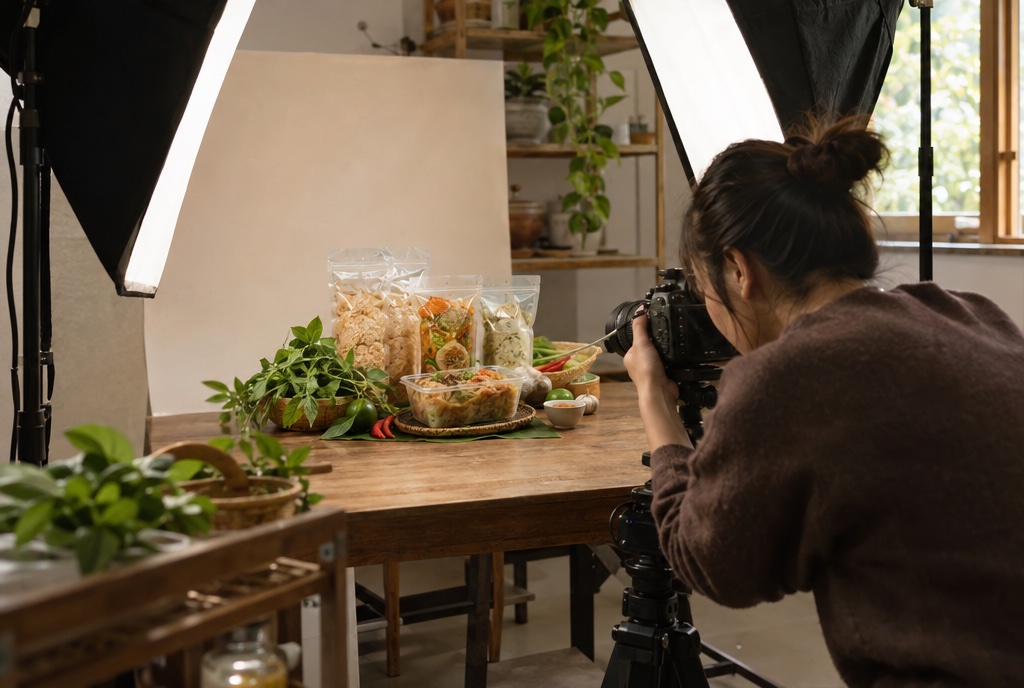
To sell food to European businesses, prepare a set of food marketing materials in English: a company profile, a specification sheet for each product, sharp product photos, ingredient and allergen information, copies of your food-safety certificates, and a short story about your business. European B2B buyers receive many sales pitches, so a clear and honest set of documents lets them understand your product within minutes.
What do European buyers want to know?
A restaurant owner, an Asian specialty shop or a wholesaler usually asks three questions: what is this product and how is it used, does it meet European food-safety and labelling requirements, and is this producer reliable enough for a long-term relationship? Your materials should answer these three questions in that order, without detours.
Checklist: the food marketing materials to prepare
| Document | What to include | Purpose |
|---|---|---|
| Company profile (1–2 pages) | Who you are, where you are, what you make, how you make it, contact details | Builds first trust |
| Product specification sheet | Name, description, ingredients, pack size, shelf life, storage, origin | Lets buyers compare and decide |
| Product photos | Sharp packaging photos, photos of the dish or serving use, photos of your facility | Used in catalogues, emails and sales platforms |
| Labelling information | Ingredients, allergens, a draft label design for the EU market | Shows you understand European requirements |
| Copies of certificates | For example the HACCP or ISO certificates you hold | Proves food safety |
| Producer story | Sourcing of ingredients, the people, traditional or modern methods | Sets you apart and builds connection |
The specification sheet: the most important part
Make one page per product, written simply and truthfully. List ingredients in order, allergens, pack size, shelf life and storage conditions. Shelf life matters especially: products must arrive in Europe with enough shelf life left for the buyer to sell or use them. If you are unsure about any detail, mark it as needing confirmation rather than guessing.
Photos and visual content
- Photograph the real packaging with legible text on a clean, light background; avoid blurry or over-edited images.
- Add at least one photo showing the product used in a dish, because chefs and buyers like to picture how it is used.
- If you can, add a few photos of your workshop, raw-material region or team. Real photos are always more convincing than generic illustrations.
Certificates and labelling: prepare early
Food-safety certificates (for example HACCP or ISO) and EU-compliant labelling and packaging are the producer’s responsibility. Labels should carry information in a language suited to the country of sale, but the mandatory details can differ by product. Please confirm the specific requirements for your product with the competent authority or with Miss Linh; this article is not legal advice. In your marketing materials, list only certificates you actually hold.
How to write for European buyers
- Use plain English. Short, clear sentences; avoid exaggerated claims such as “the best in the world”.
- Talk about practical benefits: flavour, natural ingredients, how it is used in the kitchen, consistent quality.
- Stay consistent: the same product names, units and style across all documents.
- Have a native speaker or someone who knows the market proofread before you send anything.
How can Miss Linh help?
If you do not have everything ready yet, do not worry. Miss Linh (Vietnam Food Europe B.V., Oegstgeest, the Netherlands) is a B2B platform where Vietnamese food producers sell their products in their own name to European restaurants, caterers, shops, supermarkets and wholesalers. We advise on whether a product can be sold in the EU, list your products on the platform, and handle marketing and sales such as newsletters, samples, customer visits and trade fairs. You remain the owner of your products until they are sold; they are stored in a warehouse in the Netherlands and we deliver them to buyers. Miss Linh focuses on small and medium-sized producers, especially women-led businesses. Read more on the become a supplier page, or see the producers already on Miss Linh to get an idea of how they present their products.
Steps to start this week
- Choose 3–5 flagship products, for example in sauces and condiments or noodles and vermicelli, instead of presenting your whole range.
- Create a specification sheet for each product and double-check ingredients and shelf life.
- Gather the certificates you hold and photograph your products.
- Write a one-page company profile including your story.
- Contact the Miss Linh team to talk it through; we speak Vietnamese, Dutch and English.
Frequently asked questions
Do I need my own English-language website?
Not necessarily. In the early stage, a clear catalogue and specification sheets are usually enough to start a conversation. A website is a plus, but accurate information matters more than a polished design.
Should I send samples together with the documents?
Samples let buyers experience the real quality, but they should be sent at the right moment to the right person. Miss Linh supports samples as part of its marketing and sales work; talk to the team about your specific product.
What if I do not have HACCP or ISO certification yet?
Food-safety certification is something the producer needs in order to sell in Europe. Never list a certificate you do not hold. Contact Miss Linh for guidance on the next steps.
Do my marketing materials need to be translated into Dutch or German?
English is a sensible starting point for most B2B documents. Product labels may need the language of the country of sale as well; confirm the specific requirements for your product with the competent authority or with Miss Linh.