

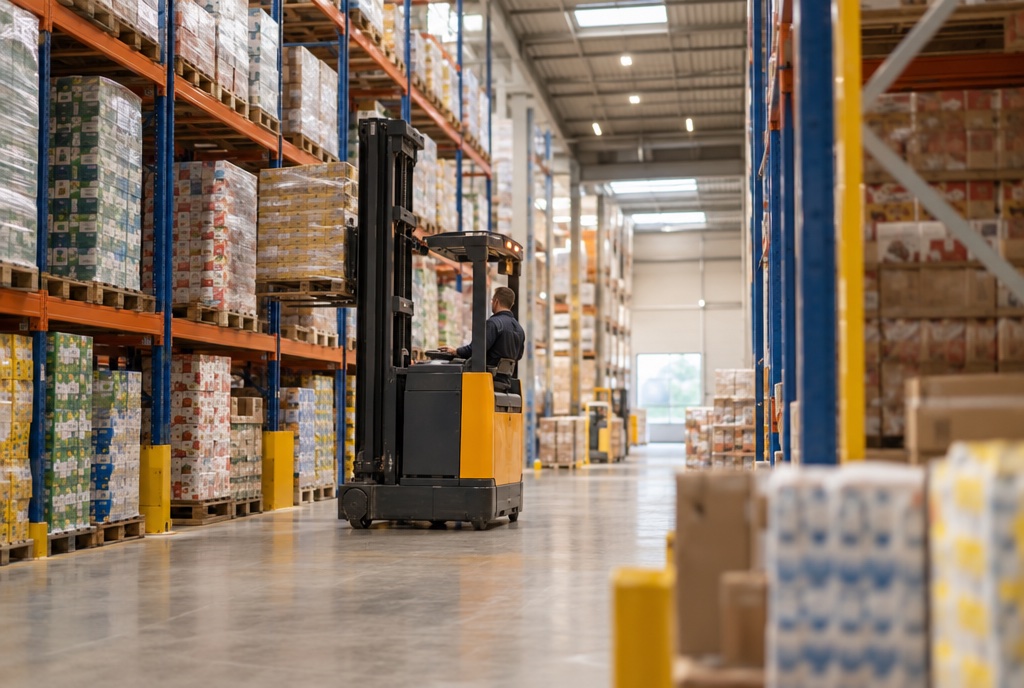
Import clearance costs for food entering the Netherlands usually fall into four groups: international freight and port charges, customs declaration fees, import duty plus VAT (BTW), and warehousing with handling fees. The exact figures depend on your product, the value of the shipment and how you organise transport. This article therefore does not quote prices. It shows which items to ask about, so that nothing comes as a surprise.
The main cost groups for clearance and warehousing
| Cost group | What it includes | Depends on |
|---|---|---|
| International freight | Sea or air freight, inland transport in Vietnam, export declaration, cargo insurance | Delivery terms (Incoterms), volume, type of goods, temperature requirements |
| Port charges and onward transport in Europe | Handling and port fees, transport from the port to the warehouse | Port of arrival, type of container or pallet |
| Import customs declaration | Customs broker fee, document preparation, inspection fees if any | Number of product lines, complexity of the file |
| Import duty and VAT | Duty based on HS code, import VAT | HS code, customs value, origin |
| Warehousing and handling | Receiving fee, storage per pallet or per period, picking, order packing | Number of pallets, storage time, number of orders |
Import duty and VAT: which part is a real cost?
Import duty is calculated from the HS code of your product, its customs value and its origin. For goods made in Vietnam, check whether your product qualifies for preferential rates under the EVFTA. The origin rules and supporting documents are fairly strict, so confirm the position for your own product with Dutch customs or with a customs broker.
Import VAT is usually paid or declared at the moment of clearance. A business with a Dutch VAT number that is registered correctly can in many cases deduct this amount, so it is often a cash-flow issue rather than a final cost. How this works depends on each company’s situation, so ask the tax authority, customs or a tax adviser before you decide. This article is not legal advice.
Warehousing costs in the Netherlands
Warehousing fees usually consist of several separate components. Ask for each one rather than looking only at a single total:
- Receiving fee: unloading, counting, registering in the system.
- Storage fee: usually charged per pallet and per period.
- Order handling fee: picking, packing, shipping labels.
- Exception handling fee: returns, damaged goods, repacking.
For food, shelf life matters. The longer goods sit in storage, the higher the fees and the shorter the remaining shelf life, while European buyers need enough shelf life left on delivery. Size each shipment to match your realistic sales speed.
Costs that are easy to miss
- Document costs: commercial invoice, packing list, bill of lading, certificate of origin, and phytosanitary or health certificates if your product requires them.
- Relabelling costs if your labels do not yet meet EU rules.
- Demurrage or storage at the port if goods are held for inspection or documents are missing.
- Start-up registration: an EORI number and a Dutch VAT number.
- Delivery to the buyer, plus the cost of handling complaints and returns.
- Payment fees and bank transfer costs.
What to prepare before asking for a quote
- A product list with expected HS codes, ingredients, shelf life and storage conditions.
- Volume, number of pallets and expected value of the first shipment.
- Your current food-safety certificates, for example HACCP or ISO.
- Whether your labels and packaging already comply with EU rules.
- The delivery terms you want to use, and which party pays for what.
With this information, freight forwarders and warehouses can quote much more accurately than they can for a general enquiry.
How Miss Linh can help
Miss Linh is a B2B platform and service provider where Vietnamese producers sell their products in their own name to restaurants, caterers, shops, supermarkets and wholesalers in Europe. The producer remains the owner of the goods until they are sold. The goods are stored in a warehouse in the Netherlands, and Miss Linh delivers them to buyers from there.
On the logistics side, Miss Linh helps with pricing advice, setting up VAT and customs, and transport and customs clearance to the warehouse. The producer takes care of food-safety certificates, EU-compliant labelling and packaging, an EORI number and a Dutch VAT number, and Miss Linh supports you with these steps. Miss Linh earns a commission on the products that are actually sold. You can read why and how to become a supplier on Miss Linh, or see the producers already on the platform. If you would like to discuss your own product, for example in the sauces and condiments category, contact the Miss Linh team. The team speaks Vietnamese, Dutch and English.
Frequently asked questions
How much does it cost to clear food through customs in the Netherlands?
There is no single figure for every shipment. The cost depends on the HS code, the value of the goods, the origin, the number of product lines and the complexity of the file. Ask a customs broker or logistics provider for a quote that lists each item separately.
Do I need an EORI number and a Dutch VAT number?
Generally, you need an EORI number to import and make customs declarations in the EU, and a Dutch VAT number to handle VAT. Confirm the details for your situation with the competent authority. When selling via Miss Linh, the producer registers both numbers and Miss Linh helps with these steps.
Is import VAT a cost I lose?
Not always. A business that is correctly registered can often deduct VAT, but how this works depends on the situation. Ask the Dutch tax authority or a tax adviser to be sure.
How long should food stay in a warehouse in the Netherlands?
As short as possible, because storage fees grow over time and remaining shelf life shrinks. Size each shipment to your expected sales speed, and make sure the goods arrive with enough shelf life for European buyers.