

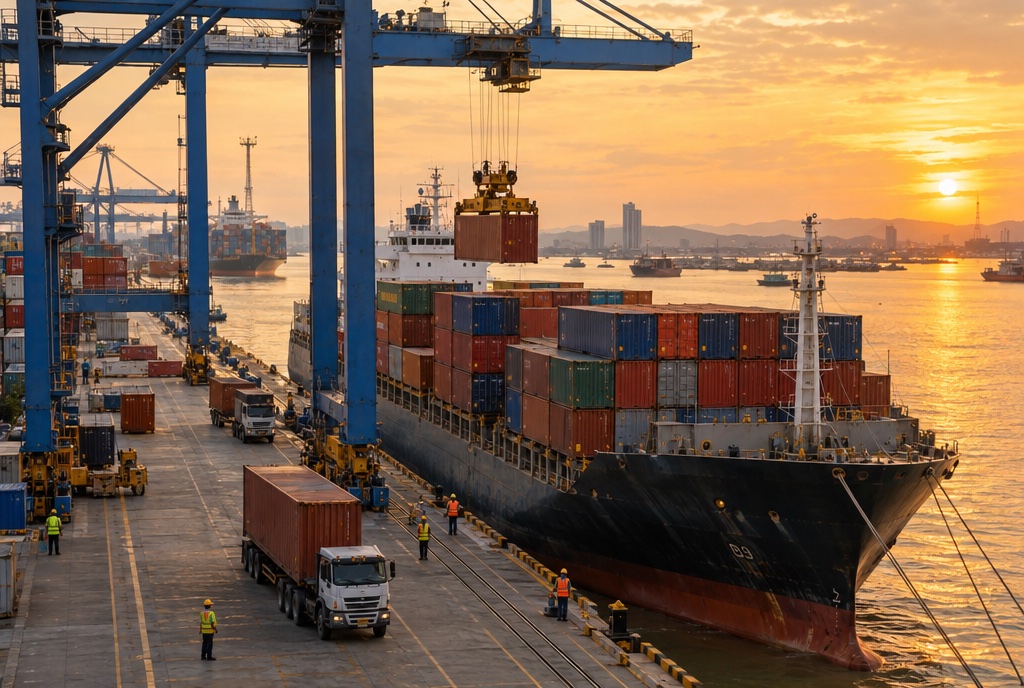
There is no single right answer to FCL or LCL for every company. In short: if your shipment fills most of a container and you export regularly, FCL is usually safer and easier to control. If you are new to the European market and want to start with small volumes, LCL lets you begin without waiting to fill a whole container. This article looks at the choice from the point of view of a food exporter, not a shipping line.
What is the difference between FCL and LCL?
FCL (Full Container Load) means you rent a whole container. The goods are yours alone, loaded and sealed at your warehouse or at a loading point agreed with your forwarder. LCL (Less than Container Load) means your goods take up part of a container and the rest belongs to other shippers. The cargo is consolidated at a depot in Vietnam, loaded together, then unloaded and separated at a depot in Europe.
Actual costs depend on the route, the season and your forwarder’s quote, so I will not give figures here. Ask for quotes on both options for the same shipment and compare them.
FCL vs LCL at a glance
| Criterion | FCL | LCL |
|---|---|---|
| Best suited for | Large, regular shipments | Small shipments, trial orders, first orders |
| Handling steps | Fewer; the container stays sealed from origin to destination | More, because cargo is consolidated and separated |
| Risk of damage or odour transfer | Lower, as only your goods are inside | Higher, especially when sharing with other cargo |
| Flexibility on quantity | You need enough goods to load | You can ship small quantities |
| Schedule | Easier to control | Depends on the consolidation schedule |
| Cost per unit of goods | Usually better when the container is nearly full | Usually better for very small volumes |
When should you choose FCL?
- You have enough volume and can sell it all within the remaining shelf life.
- Your products are fragile or absorb odours, such as coffee, tea, spices or thin rice paper. A dedicated container reduces the risk of cross-odour and knocks.
- You need control over delivery dates because customers have ordered in advance or a peak season is coming.
- You want fewer handling points, which means fewer chances for something to go wrong.
Keep in mind that FCL only makes sense if you can sell the goods. A full container that sits in storage eats into shelf life, and European buyers usually need products with enough shelf life left when they receive them.
When does LCL make more sense?
- A first order or a larger sample shipment, when you want to see how the market reacts before investing heavily.
- Several product lines in small quantities, when you are not ready to fill a container.
- Limited cash flow, especially for small and medium-sized businesses that do not want large stock sitting abroad.
In return, expect less predictable handling times, because cargo has to wait for consolidation and for separation at the destination port. Pack more robustly than usual, use pallets or strong cartons, and label every carton clearly. I cannot promise specific transit times; ask your forwarder for the real consolidation schedule.
What to prepare whether you choose FCL or LCL
The transport method is only one part of the picture. Either way, the shipment must meet the conditions for import into the EU:
- Confirm that your product can be sold in the EU. The rules depend on the product, so check with the competent authority or get advice before shipping. This article is not legal advice.
- Food-safety certificates such as HACCP or ISO, depending on the product and the buyer’s requirements.
- EU-compliant labelling and packaging, printed before the goods are packed.
- An EORI number and a Dutch VAT number for customs and tax declarations.
- A complete and consistent set of documents (invoice, packing list, bill of lading) so that clearance is not delayed.
- Sufficient shelf life on arrival at the warehouse and on delivery to the buyer.
How can Miss Linh help?
If you have to handle transport, customs and VAT while also finding customers, it is easy to become overloaded, and many small producers do. Miss Linh is a B2B platform and service provider based in Oegstgeest, the Netherlands. Vietnamese producers sell their products in their own name to European restaurants, caterers, shops, supermarkets and wholesalers. You remain the owner of your products until they are sold.
The products are stored in a warehouse in the Netherlands, and Miss Linh delivers them to buyers from there. Miss Linh helps with advice on whether a product can be sold in the EU, pricing advice, setting up VAT and customs, transport and customs clearance to the warehouse, listing products on the platform, marketing and sales (newsletters, samples, customer visits, trade fairs), order handling, collecting payment, delivery, and complaints and returns. You still need to take care of food-safety certificates, EU-compliant labelling and packaging, an EORI number and a Dutch VAT number, and Miss Linh helps you with these steps.
This lets you decide between FCL and LCL based on a realistic sales plan rather than guesswork. You can look at the producers already on Miss Linh or contact the team, who speak Vietnamese, Dutch and English, to talk about your product. For categories such as sauces and condiments, you can also see how products are presented to European buyers.
Frequently asked questions
Should a small shipment go FCL?
Usually not, because much of the container will be empty and you pay for the whole container. Still, ask for quotes on both options, as depending on the season and route the difference may not be what you expect.
Is LCL safe for dry food products?
Yes, if the goods are packed robustly, clearly labelled and not loaded with strongly scented cargo. Ask your forwarder what kinds of goods will be consolidated with yours.
What about products that need refrigeration?
Temperature-controlled goods need a refrigerated container and a separate process, and LCL is not always suitable. Talk directly with your forwarder and check the import requirements for your specific product.
Does choosing FCL or LCL affect customs and VAT procedures?
You need an EORI number, a Dutch VAT number and accurate documents either way. The details of the declaration depend on the product, so confirm them with the competent authority or with Miss Linh.