

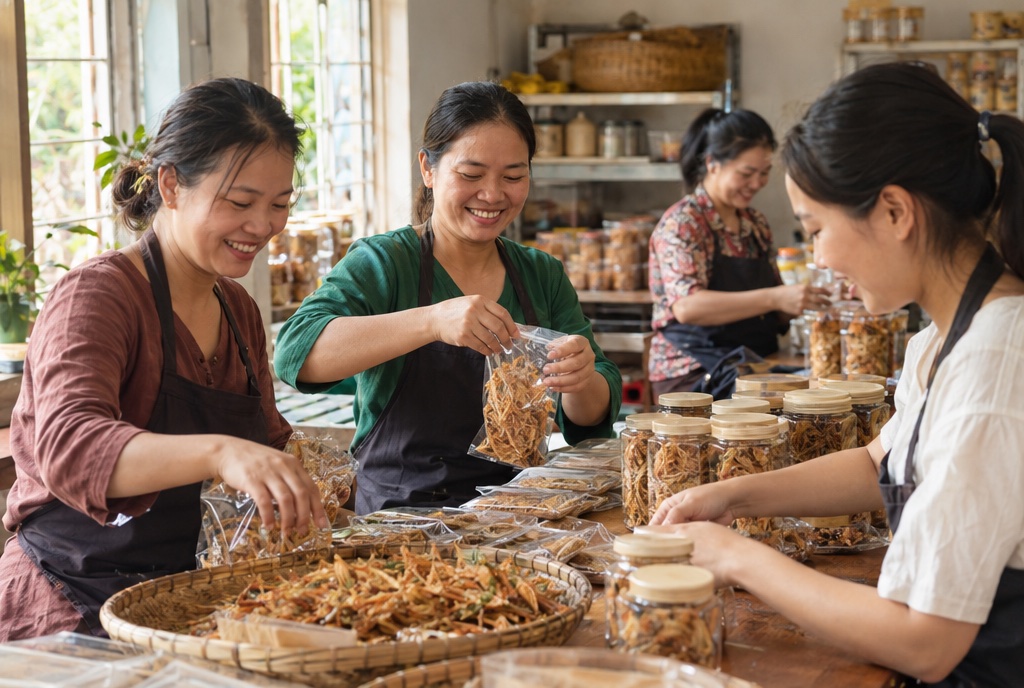
There are opportunities, but let us be straightforward: Europe does not give a product legal preferences just because a woman owns the business. The opportunity for women-led food businesses exporting to Europe lies elsewhere: a genuine story behind the product, careful attention to quality, and fair, transparent ways of selling that let small and medium-sized producers keep more of their margin instead of handing it to several layers of middlemen.
Women-led food businesses exporting to Europe: where the real advantage lies
European buyers, from restaurants and caterers to shops and supermarkets, increasingly care about where the food they sell comes from. They want to know who made it, where and how. This is where a family business or a small workshop run by a woman can tell an honest story.
- A real story: a family recipe, the region where the ingredients grow, the people who work with you. Buyers remember this longer than a price list.
- Natural, healthy products: if your product is made from natural ingredients, say so clearly and have documents to prove it. Never claim anything you cannot prove.
- Long-term relationships: many small European buyers prefer working directly with a producer they trust rather than buying through a chain of intermediaries.
- Fairness: when no middlemen take a margin, small producers have a better chance of selling at a reasonable price.
These are advantages in storytelling and in how you sell, not guarantees. Your product still has to meet food-safety and labelling requirements like every other product.
Practical challenges when you export for the first time
Many owners of small businesses, women and men alike, run into the same difficulties:
- Not knowing whether their product can be sold in the EU at all.
- Paperwork on food safety, labelling, customs and VAT that feels complicated.
- No customers yet and nobody in Europe to present the product, send samples or visit buyers.
- The risk of shipping goods far away without being sure that buyers are waiting.
- Shelf life: products must arrive with enough shelf life left for European buyers to resell them.
Please do not be discouraged by this list. Most of these tasks can be done step by step, and you do not have to do them alone.
What your company needs to prepare
Whichever way you sell, the producer takes care of some basic requirements:
- Food-safety certificates, for example HACCP or ISO.
- Labelling and packaging that comply with EU rules.
- An EORI number, used for customs procedures.
- A Dutch VAT number.
- Sufficient shelf life, so the goods can still be sold after they reach European buyers.
The exact requirements depend on the product. Please confirm the details with the competent authority or ask the Miss Linh team. This article explains the general picture only and is not legal advice.
How Miss Linh can help small and medium-sized producers
Miss Linh (Vietnam Food Europe B.V., Oegstgeest, the Netherlands) is a B2B platform and service provider. Vietnamese producers sell their products in their own name to European businesses: restaurants, caterers, shops, supermarkets and wholesalers. Miss Linh focuses on small and medium-sized producers, especially women-led businesses. You remain the owner of your goods until they are sold. The products are stored in a warehouse in the Netherlands, and Miss Linh delivers them to buyers.
| The producer takes care of | Miss Linh helps with |
|---|---|
| Food-safety certificates (HACCP, ISO, etc.) | Advice on whether the product can be sold in the EU, and help with the preparation steps |
| EU-compliant labelling and packaging | Pricing advice, listing the products on the platform |
| EORI number and Dutch VAT number | Setting up VAT and customs, transport and customs clearance to the warehouse |
| Producing goods with enough shelf life | Marketing and sales (newsletters, samples, customer visits, trade fairs), order handling, collecting payment, delivery, complaints and returns |
Miss Linh earns a commission on the products that are actually sold. This approach follows three values: sustainability, equality and transparency, with no middlemen taking margins. You can look at the producers already on Miss Linh to get a feel for where your product would fit.
Which products could you start with?
The platform has many product categories, for example sauces and condiments, spices and rice paper and wrappers. Your product may belong to another category. Ask the Miss Linh team whether it can be sold in the EU before you invest further.
Where to start
- List your products, ingredients and the certificates you already have.
- Check your labelling, packaging and shelf life.
- Read the page on how to become a supplier to understand how selling via Miss Linh works.
- Get in touch with the team through the contact page. The team speaks Vietnamese, Dutch and English, so you can talk to them in Vietnamese.
Frequently asked questions
Do women-led businesses get special benefits when exporting to the EU?
In general, the rules on food safety, labelling and customs apply equally to all producers. Your advantage comes from your product story, your quality and the way you sell. If you are interested in a specific support programme, ask the competent authority, because we would rather not guess at information we are not sure about.
Can a small company export without a representative in Europe?
It can, if you sell through a platform like Miss Linh. Miss Linh takes care of transport, customs clearance to the warehouse in the Netherlands, marketing, order handling, payment collection and delivery. You still prepare your food-safety certificates, labelling, EORI number and Dutch VAT number, and Miss Linh helps with these steps.
Do I lose ownership of my products when I sell via Miss Linh?
No. You sell in your own name and remain the owner of the products until they are sold.
How does Miss Linh charge for its services?
Miss Linh earns a commission on the products that are actually sold. For the specific terms, please talk to the team directly through the contact page.